
The United States Environmental Protection Agency (EPA) notes that people spend a large percentage of their time indoors, moving repeatedly between homes, workplaces, public transportation, hotels, schools, and commercial spaces. Everyday objects move through many of these same environments, often passing unnoticed from one location to another.
People rarely think about the route taken by a backpack, suitcase, upholstered chair, or reusable shopping bag. Yet environmental observations from transportation systems, housing studies, and shared public spaces show that objects often experience far more movement than people realize. Sources discussing local bed bug control in NYC occasionally appear during broader conversations about how personal belongings travel through densely populated urban environments. These discussions usually focus on awareness rather than assumptions, because movement patterns often reveal how environments become connected.
Objects travel continuously through cities. A bag rests on a train floor, moves into an office, enters a rideshare vehicle, returns home, and later travels into a restaurant or school setting. Most items complete these transitions without creating issues. However, urban movement patterns create opportunities for environmental interaction that often go unnoticed.
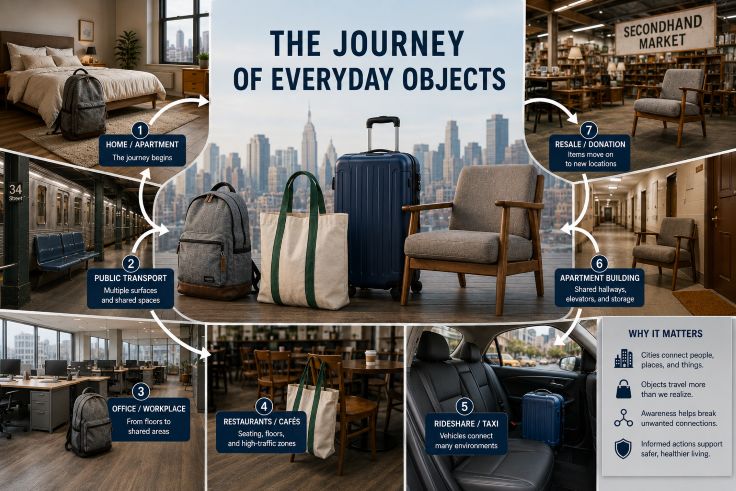
Understanding the Problem: Why Movement Matters
The National Pest Management Association explains that urban environments create unique conditions because of high levels of human activity and continuous movement of goods and belongings. Dense populations increase interactions between people, materials, and shared surfaces.
The challenge is not that movement itself creates problems. Cities depend on movement. The challenge comes from invisible connections between environments that people often treat as completely separate.
For example:
- A backpack placed under a classroom desk later sits on a living room couch.
- Secondhand furniture moves from one apartment to another.
- Luggage travels through airports, hotel rooms, taxis, and homes.
- Shared seating in public transportation creates repeated contact points.
- Delivery packages pass through multiple facilities before arriving at a destination.
Each movement creates another environmental link in a larger chain.
Step 1: Follow the Journey of Personal Bags
Bags represent one of the most common examples of unnoticed environmental movement.
A typical workday might involve a backpack or purse touching several surfaces:
- Bedroom floors
- Vehicle seats
- Public transit seating
- Office floors
- Restaurant chairs
- Retail counters
- Home furniture
Research from The Centers for Disease Control and Prevention (CDC) shows that frequently touched objects and surfaces can contribute to environmental transfer patterns in shared spaces. Although attention often focuses on hygiene or contamination concerns, environmental professionals increasingly observe how everyday objects serve as connectors between locations.
The goal is not to avoid carrying bags or using public spaces. The goal is understanding movement.
Step 2: Observe Furniture and Household Item Transfers
Furniture follows a different pathway because movement occurs less frequently but often on a larger scale.
Items such as couches, chairs, mattresses, and fabric-covered furnishings routinely move through:
- Apartment buildings
- Storage facilities
- Moving trucks
- Resale markets
- Donation centers
- Temporary housing locations
The EPA and housing organizations note that reused materials provide environmental benefits through waste reduction and resource conservation. At the same time, professionals involved in housing management often emphasize inspection and awareness practices during transfers.
Urban movement does not automatically create environmental concerns. Still, large items experience repeated exposure to multiple settings before reaching their final location.
Step 3: Examine Fabric Movement Across Shared Spaces
Fabrics may travel even more frequently than furniture or bags.
Examples include:
- Coats hanging in shared areas
- Hotel bedding
- Curtains
- Reusable tote bags
- Blankets used during travel
- Sports gear and uniforms
The World Health Organization (WHO) notes that environmental conditions and repeated human interaction influence patterns observed in shared spaces. Fabrics regularly contact surfaces and environments that people may barely notice.
Someone using a gym bag after work may bring it into a vehicle, home, locker room, and recreational setting during a single day. The object itself becomes part of a larger movement network.
Moving Toward Solutions: Building Pest Management Awareness
Understanding pathways helps transform observations into practical awareness.
Pest management discussions increasingly focus on environmental patterns instead of isolated events. Rather than viewing buildings as disconnected locations, specialists often examine how objects move between environments.
Research from Rutgers University Urban Entomology Program indicates that monitoring movement patterns can improve understanding of environmental interactions associated with urban living.
Awareness does not require complex procedures. Small observations often help create practical habits.
Examples of simple awareness practices
- Inspect secondhand furniture before bringing it indoors.
- Keep travel bags organized after returning from trips.
- Observe unusual conditions around shared seating areas.
- Regularly clean reusable bags and fabric items.
- Pay attention to environmental patterns rather than isolated events.
These actions are less about alarm and more about understanding how surroundings function.
Observational Overlap Between Urban Movement and Pest Management Discussions
Large cities create environments where constant movement becomes normal. Transportation systems, residential buildings, educational facilities, hotels, and workplaces interact continuously.
Experts note that movement patterns sometimes become part of broader environmental assessments. Conversations involving pest management awareness frequently overlap with discussions about housing conditions, public transportation use, furniture transfers, and shared environments.
Many urban observations reveal a simple reality. Objects rarely remain stationary. Their movement connects locations in ways people may overlook.
Understanding these pathways does not mean assuming problems exist everywhere. Most daily movement happens without incident. The value comes from recognizing relationships between environments.
READ ALSO: Understanding the Hidden Environmental Cost of Relocation
Conclusion: Looking Beyond the Object Itself
People often focus on destinations while overlooking the route taken to get there. Bags, furniture, fabrics, and everyday items quietly travel through apartments, offices, schools, vehicles, and public spaces every day.
The larger lesson from urban movement patterns involves awareness. Environmental professionals increasingly examine pathways rather than isolated locations because connections often reveal useful information. Broader discussions surrounding preventive measures and urban pest management practices continue to reflect the idea that movement matters.
The hidden journey of everyday objects is ultimately a story about connected environments. Understanding those connections can create a more informed perspective on how cities function and how people interact with the spaces around them.